



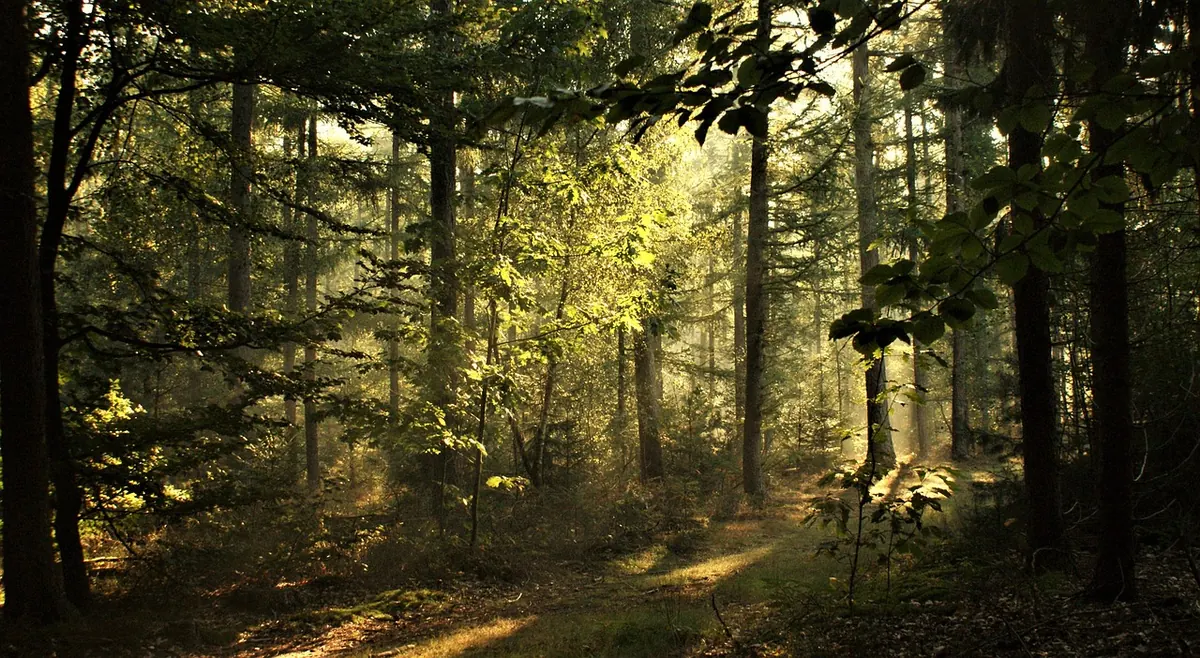
Most woodland journals fail in the same quiet way. The first entry is long and enthusiastic: a full page, a pressed leaf, a sketch of the clearing. The second is shorter. By the fourth, the notebook is at the bottom of a bag and the walk has gone back to being just a walk. What kills these journals isn't laziness. It's friction — the business of choosing somewhere new, driving there, and finding your bearings all over again.
A local patch journal removes that friction. You pick one route close to home, walk it repeatedly, and write it down. Not a different wood every weekend, but the same wood, forty or fifty times, until you know where the ground stays wet in July and which tree loses its leaves first.
Why one path teaches more than ten
Novelty is a poor teacher. A new wood gives you scenery; a familiar wood gives you sequence. When you walk the same route in February and again in May, you're not collecting impressions, you're comparing them — and comparison is where the noticing happens.
There's also the matter of individuals. After a dozen visits you stop seeing "a beech wood" and start seeing the beech with the split trunk, the ditch that holds water longer than any other, the gap in the canopy where the light gets through at four in the afternoon. That specificity is what makes a journal worth rereading. A page that says "lovely woodland, lots of birdsong" is dead on the page. A page that says "the hawthorn by the gate is still bare; the one forty metres on has bud-burst on the south side only" will still be interesting in three years.
Choosing your route
Practical criteria matter more than scenic ones. Look for a circuit or out-and-back you can complete in under an hour — ideally something you can reach on foot, or within ten minutes of driving, so a low-motivation day still gets an entry. A loop of one to three kilometres is plenty; you'll cover a surprising amount of ground over a year.
Choose a route with variety packed into a small area: a wet hollow, a dry ridge, a hedged edge, a stand of mature trees, a clearing or a gap where a tree came down. Each of those is a different habitat with a different calendar, and every one gives you something to write about when the rest of the wood is quiet.
Check access before you commit. Stick to public paths or land where you have permission, and note in your first entry where the boundaries are. If the route crosses working forestry or farmland, be prepared to record closures and diversions as part of the journal rather than treating them as interruptions. And tell someone where you're going if the patch is remote or the phone signal drops.
Setting up the journal
One notebook, one pen, one format. The format is the important part: the same fixed fields every visit, so that March's entry can be laid against October's without guesswork. A line or two per field is enough.
- Header: date, time in, time out, who you're with, and what the weather is doing in plain words — cloud, wind direction, whether it rained this morning.
- Ground underfoot: dry, damp, standing water, mud depth, ice, leaf litter. This is the field people skip and later wish they hadn't.
- Three sentinels: pick three fixed features — the hawthorn by the gate, the ditch, the fallen log — and check each one every visit, even if only to write "no change".
- Firsts and lasts: first bud-burst, first frost, last swifts overhead, first fallen acorns. Keep a running list at the back of the notebook.
- Wildlife: what you saw and heard, plus signs — tracks in mud, feeding debris, droppings, burrows, a scatter of feathers.
- Human traces: litter, cut branches, a new desire path worn through the bracken, tyre ruts, repairs to a gate.
- One line of free writing: whatever struck you, unedited. This is the part that keeps the journal alive.
Photographs are useful as an index, not as the record. If you use your phone, pick one fixed spot and one fixed framing — a "photo point" — and shoot it each time. The same view through the seasons will show you things the written entries miss, especially changes in canopy and undergrowth. But take the photo second; write first, or you'll spend the walk looking at a screen.
What to record through the year
Seasonal markers
Track the calendar of a handful of plants and trees rather than everything. Leaf-out, leaf-fall, first flowering, first bare branch. Note which side of the tree the first buds open on, and whether that holds true across the season. Over a year you'll build a small, local, personal record of how the wood moves from one state to the next — one that's more useful to you than any general guide, because it's tied to a place you actually walk.
Wildlife patterns
Resist the species list. A tick-box list of birds is satisfying for a week and dull forever. Instead, note behaviour and timing: where the pigeons gather, which hedge the small birds work along, when the squirrel activity shifts from ground to canopy, whether the dawn chorus is loud at the gate but thin in the conifers. Record sound as carefully as sight. "Nuthatch calling from the third oak, twice, both times near the fork" is a better entry than "nuthatch".
Route conditions
Treat the path as a living thing. Where does water stand after rain, and how long does it take to drain? Which stretch gets churned to mud, and who churns it? Where is the undergrowth encroaching, and where has it been cut back? Logging erosion, fallen limbs, overhanging brambles and broken stiles builds a quiet record of how a route is used and how it wears. It's the least romantic part of the journal and often the most concretely useful.
The habit of reading backwards
Before you set out, read your entry from three months ago. Before you write, read the last two. This small ritual does more for the journal than any resolution about visiting weekly. It puts the current visit in context and pushes you past the obvious observations: not "the wood is green now" but "the wood is greener than this time last year, and the bluebells are further along by the gate than by the stream".
Don't chase rarities. A kingfisher is a fine thing to see, but a journal built around exceptional sightings is empty on ordinary days — and most days are ordinary. A dull entry recording bare branches, wet ground and nothing much moving is still a data point, and often the one you'll want later.
Keeping it going
Set a rhythm you can actually sustain. Twice a month is realistic for most people, and it beats an ambitious weekly plan that collapses in April. Fix a day if that helps, but allow yourself to move it — the point is the route, not the schedule.
Have a minimum entry. On a bad day, five lines will do: date, weather, ground, the three sentinels, one sentence. The notebook stays in the same place, near the door, with the pen clipped to it. Go in bad weather at least occasionally; rain, fog and wind change the wood more than sunshine does, and those entries tend to be the ones you remember writing.
Once a season, sit down with the whole journal for twenty minutes and read it end to end. Mark the pages where something shifted. That's when a stack of ordinary walk notes turns into a record of a place — and when you start planning next year's version of the same route.
Photo: FotoRieth / Pixabay
Related posts
More stories you’ll love reading