

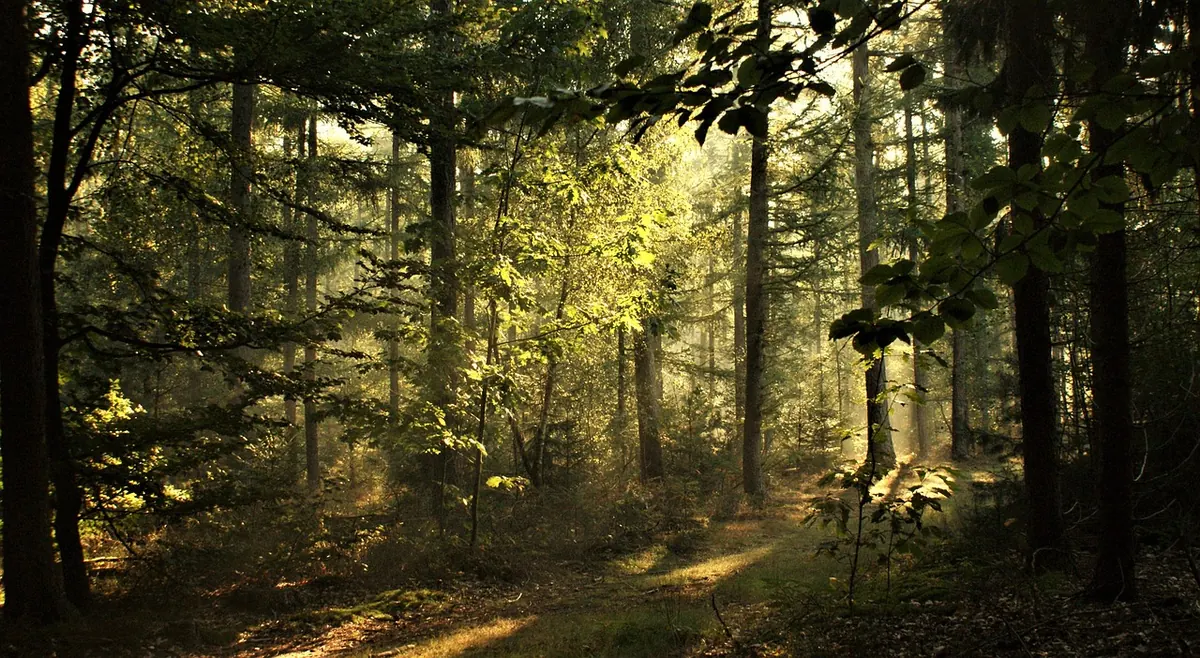



The first entry is the hardest. You sit on a mossy stump, notebook open, pen hovering, and the forest offers nothing you can put into words — just green, and wind, and the distant knock of a woodpecker. That is normal. A forest journal is not a nature documentary transcript. It is a record of attention, kept long enough that you begin noticing what you used to walk past.
The plan below takes thirty days. It asks for ten to fifteen minutes, a notebook that fits in a pocket, and no ambition beyond showing up. By the end you will have a filled notebook, a handful of places you know by name, and a habit with roots.
What a Forest Journal Is, and What It Isn't
It is not a field guide you write yourself, and it is not a diary with leaves in it. The most useful forest journals hold two kinds of things side by side: what happened outside, and what happened in you while you watched. A date, a place, a temperature. Then a line about the light, and a line about your impatience.
Accuracy matters more than beauty. If you write "small brown bird," that is an honest entry. If you guess and write "sparrow" without looking, you have taught yourself to guess. Leave space to come back and correct things. Your journal should be allowed to be wrong on Tuesday and right in March.
A page written badly still counts. A page not written does not.
Assemble a Small Kit
Buy nothing expensive. The best forest journal is the one you are willing to drop in the mud, and a cheap notebook removes the fear of ruining it.
- A pocket notebook — A6 or smaller, hard cover, sewn binding so pages don't fall out when it gets wet.
- A pencil — it writes on damp paper, in cold, upside down.
- A fine-liner or waterproof pen — for dates and anything you want to stay legible.
- A zip bag — the whole kit lives in it, so rain is not a reason to go home.
- A short strip of masking tape — for pressing a leaf flat against a page and labelling it.
Keep a sharpener and a second pencil in your coat pocket. One pencil is a plan; two is a habit.
Week One: Establish the Ground (Days 1–7)
This week is about repetition, not discovery. Go to the same place at roughly the same time and write something short each day. Same place matters: familiarity is what makes small changes visible later.
- Sit in one spot for ten minutes. Write only what you can hear.
- Draw a rough map of your route from memory, then walk it and correct the map.
- Choose one tree. Note the bark, one leaf, and whatever grows at its base.
- Record the weather in plain words, plus how the air felt on your hands.
- Write down five smells. If you can't name them, describe them by comparison.
- List every sound made by something smaller than your hand.
- Write one sentence about arriving. Another about leaving.
Week Two: Slow Down and Measure (Days 8–14)
Now you start looking properly, which mostly means looking longer. Set a timer if you fidget. The prompts below work in any woodland, in any season.
- Pick one square metre of ground and list everything in it, including the dead and the invisible.
- Sketch the tree from Day 3 again. Do not aim for pretty.
- Count the birds you hear but never see.
- Follow the light: where it falls, what it touches, where the shadow edges sit.
- Find three signs of animals without seeing a single animal.
- Write a paragraph in the present tense, as it is happening.
- Reread the week and underline one detail you had already forgotten.
Week Three: Follow One Thread (Days 15–21)
By the middle of the month you will have noticed something you can't explain. That is the point at which a journal stops being an exercise and becomes a project.
- Write one question at the top of a page. When do the ferns unroll? Who eats these seeds?
- Gather evidence for that question, even if the evidence is a shrug.
- Write the next question your answer raises.
- Visit at a different hour — early morning, or the last of the light.
- Write a full page using no adjectives at all.
- Copy one small thing exactly: leaf veins, a feather's pattern, lichen on a stone.
- Press something flat and label it with date and place. Not everything — one thing.
Week Four: Make It Yours (Days 22–30)
- Write the entry you would want to read in ten years.
- Note what has changed since Day 1 — in the forest, and in your routine.
- Bring a friend, or leave your phone at home. Record the difference.
- Start a list of everything you still cannot identify. Keep it growing.
- Do a five-minute entry. Just five. Time it.
- Write briefly about the weather you would normally stay home for, from outside, and only if it's safe to be out.
- Build an index at the back: date, place, one word.
- Fill a page with the questions you would ask a forester or a botanist.
- Write one honest page about whether you will keep going, and what would make that easier.
A Routine That Survives Weather
The ten-minute rule
Commit to ten minutes, not to a good entry. Most days the ten minutes stretch into twenty-five. On the bad days you still have a page, and a page is the whole game.
Anchor it to something you already do
The walk to work, the dog, the school pickup, the same bench on a Sunday. A journal attached to an existing habit needs willpower only once; a journal that requires a special trip needs it every time.
When you miss a day, miss it
Do not backfill and do not punish yourself with a double entry. Write the next day's date and continue. A thirty-day plan with twenty-four entries has worked; a plan abandoned on Day 9 because of two gaps has not.
Adjust for the season
In summer, go early and write in the shade. In winter, shorten the walk, keep the pencil in an inside pocket so the lead isn't cold and brittle, and write more about what's absent — the silence, the bare branches, the tracks in mud.
What to Write When Nothing Happens
Some days the forest is closed for business. Copy the same view in five different weathers. Write down the last thing that surprised you. Describe the walk to your spot rather than the spot itself. Measure something with your hand — how many palms wide is the trunk, how deep is the leaf litter. Write the entry you would give to someone who has never been here and never will.
If you're heading somewhere remote, tell someone your route and turn back well before the light does. A journal is not worth a twisted ankle.
Start With Tomorrow's Ten Minutes
You do not need the right notebook, the right forest or a free weekend. Choose a spot within walking distance, put a pencil in your pocket, and write for ten minutes tomorrow. Then do it again.
On Day 30, read the first page and the last one together. That gap — between the person who wrote "small brown bird" and the one who now knows what it was — is the whole reason to keep a forest journal.
Photo: kaboompics / Pixabay
Related posts
More stories you’ll love reading